
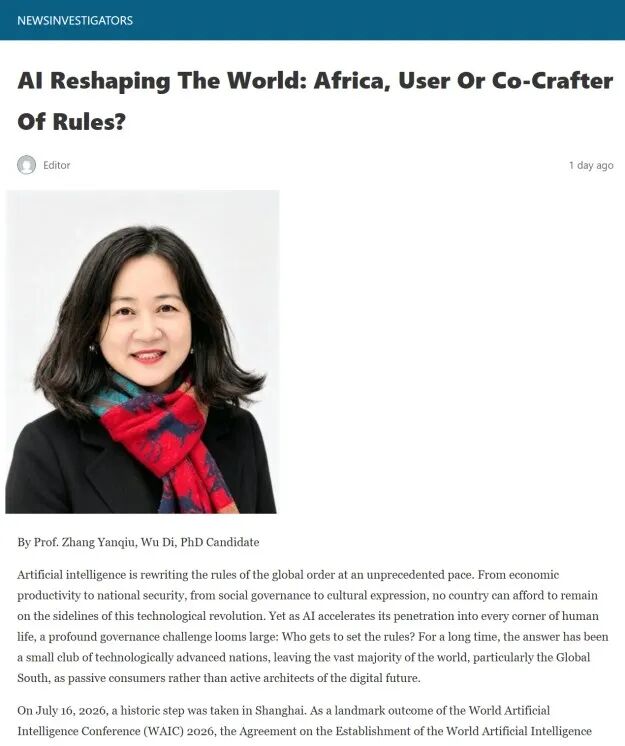
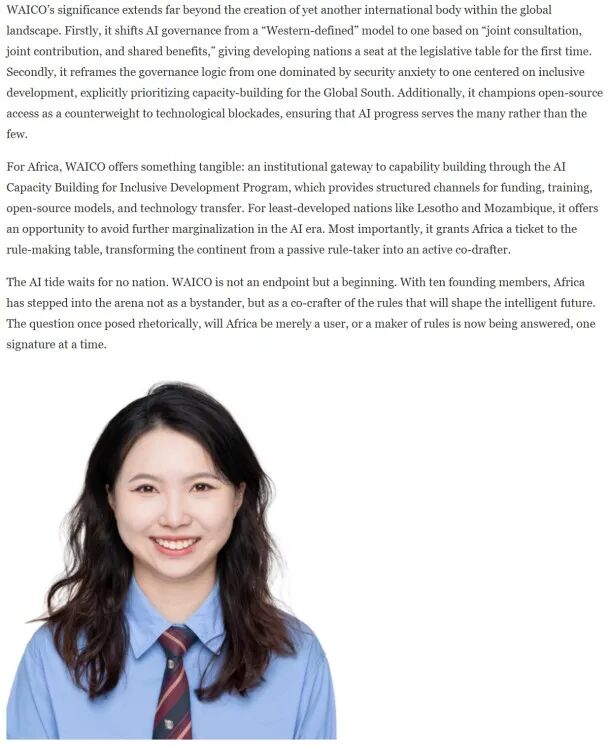
8月2日,尼日利亚主流资讯平台News Investigators刊发中国传媒大学人类命运共同体研究院副院长、区域国别传播研究院非洲传媒研究中心主任张艳秋教授与区域国别学博士生吴荻共同撰写的评论文章《AI重塑世界:非洲,是使用者还是规则共创者?》(AI Reshaping The World: Africa, User Or Co-Crafter Of Rules?)。文章围绕世界人工智能合作组织(WAICO)的成立展开深度分析,指出这一全球首个聚焦AI治理的政府间国际组织的诞生,标志着非洲正从全球数字规则的被动接受者,转向智能时代治理规则的主动共创者。
文章指出,人工智能正在全方位重塑全球秩序,但长期以来AI治理规则由少数发达国家垄断,全球南方只能被动接受数字技术成果。2026年7月16日,《关于成立世界人工智能合作组织的协定》在2026年世界人工智能大会上正式签署,29个创始国覆盖各大洲,全球南方占主体,非洲以10个创始成员国席位成为第二大区域力量,打破了少数国家垄断技术规则制定的旧格局;当前非洲AI 发展意识全面觉醒,非盟出台大陆统一AI战略,南非、肯尼亚等国也推进配套治理框架与算力布局建设,而中国是非洲数字崛起进程中不可或缺的合作伙伴,中非数字合作早已超越传统数字基建范畴,延伸至全维度的AI能力建设,践行共商共建共享的发展合作思路。
文章阐释WAICO拥有三重核心价值:重构AI治理主导权、把包容发展与南方国家能力建设放在首位、依靠开源开放破解技术壁垒。依托组织配套的AI包容发展能力建设计划,非洲各国可获取资金、技术、培训等系统帮扶,弱势非洲国家能够规避数字边缘化困境,更关键的是非洲由此获得全球AI规则共创资格,完成从规则使用者到共同制定者的身份转变,WAICO的成立标志非洲正式跻身全球智能治理核心舞台,也为“非洲究竟是技术消费者还是规则共创者”这一命题给出明确回应。
以下是文章全文:
AI Reshaping The World: Africa, User Or Co-Crafter Of Rules?
By Prof. Zhang Yanqiu, Wu Di, PhD Candidate
Artificial intelligence is rewriting the rules of the global order at an unprecedented pace. From economic productivity to national security, from social governance to cultural expression, no country can afford to remain on the sidelines of this technological revolution. Yet as AI accelerates its penetration into every corner of human life, a profound governance challenge looms large: Who gets to set the rules? For a long time, the answer has been a small club of technologically advanced nations, leaving the vast majority of the world, particularly the Global South, as passive consumers rather than active architects of the digital future.
On July 16, 2026, a historic step was taken in Shanghai. As a landmark outcome of the World Artificial Intelligence Conference (WAIC) 2026, the Agreement on the Establishment of the World Artificial Intelligence Cooperation Organization (WAICO) was officially signed. Twenty-nine nations gathered to inaugurate the world’s first intergovernmental organization dedicated exclusively to AI governance, with its permanent headquarters located in Shanghai. United Nations Secretary-General António Guterres attended the signing ceremony, emphasizing that open-source development represents a critical pathway toward universal access to AI capabilities.
What makes WAICO particularly noteworthy is the composition of its membership. The 29 founding members span Asia, Africa, the Americas, and Europe, with a clear majority hailing from the Global South. Africa stands out as the second-largest regional bloc, with ten founding members, South Africa, Ethiopia, Algeria, the Republic of the Congo, Kenya, Lesotho, Mozambique, Senegal, Zambia, and Cameroon, representing a level of participation virtually unheard of in any previous global technology governance mechanism. This sends an unmistakable signal: AI governance can no longer be defined behind closed doors by a handful of wealthy nations.
Africa’s elevated status at the WAICO table is not merely symbolic, it reflects a continent undergoing a genuine AI awakening. In 2024, the African Union formally adopted the Continental Artificial Intelligence Strategy for 2025-2030, marking a shift from fragmented national initiatives to a systematic, continent-wide approach. South Africa, the continent’s most mature digital economy, has emerged as an “AI regulatory showcase,” advancing a phased, multi-agency governance framework and elevating AI governance to a central position on the agenda of BRICS summits. Kenya, East Africa’s “Silicon Savannah,” has embedded measurable KPIs for data sovereignty, green computing power, and local models into its 2025-2030 national AI strategy, complemented by the newly launched QubitHub computing center in Nairobi.
China has been an indispensable partner in Africa’s digital ascent. Bilateral cooperation has evolved beyond traditional digital infrastructure to encompass extensive AI capacity-building—from secure data centers that safeguard African data sovereignty, to open-source large language models adapted for Swahili, Hausa, and Amharic, to systematic talent development through Luban Workshops and joint research centers. This “teaching one to fish” model embodies precisely the development-oriented approach that WAICO seeks to institutionalize.
WAICO’s significance extends far beyond the creation of yet another international body within the global landscape. Firstly, it shifts AI governance from a “Western-defined” model to one based on “joint consultation, joint contribution, and shared benefits,” giving developing nations a seat at the legislative table for the first time. Secondly, it reframes the governance logic from one dominated by security anxiety to one centered on inclusive development, explicitly prioritizing capacity-building for the Global South. Additionally, it champions open-source access as a counterweight to technological blockades, ensuring that AI progress serves the many rather than the few.
For Africa, WAICO offers something tangible: an institutional gateway to capability building through the AI Capacity Building for Inclusive Development Program, which provides structured channels for funding, training, open-source models, and technology transfer. For least-developed nations like Lesotho and Mozambique, it offers an opportunity to avoid further marginalization in the AI era. Most importantly, it grants Africa a ticket to the rule-making table, transforming the continent from a passive rule-taker into an active co-drafter.
The AI tide waits for no nation. WAICO is not an endpoint but a beginning. With ten founding members, Africa has stepped into the arena not as a bystander, but as a co-crafter of the rules that will shape the intelligent future. The question once posed rhetorically, will Africa be merely a user, or a maker of rules is now being answered, one signature at a time.
原文链接:
https://newsinvestigatorsng.com/ai-reshaping-the-world-africa-user-or-co-crafter-of-rules/?amp=1