
5月25日,尼日利亚英文新闻媒体《新闻调查者》(News Investigators)“Viewpoint”栏目刊发了中国传媒大学人类命运共同体研究院副院长、区域国别研究院非洲传媒研究中心主任张艳秋教授和国际传播白杨班博士生方火建共同撰写的新闻评论文章《中国零关税:为什么尼日利亚的回应关乎西非和非洲》(China’s Zero-Tariff: Why Nigeria’s Response Matters for West Africa and Africa)。
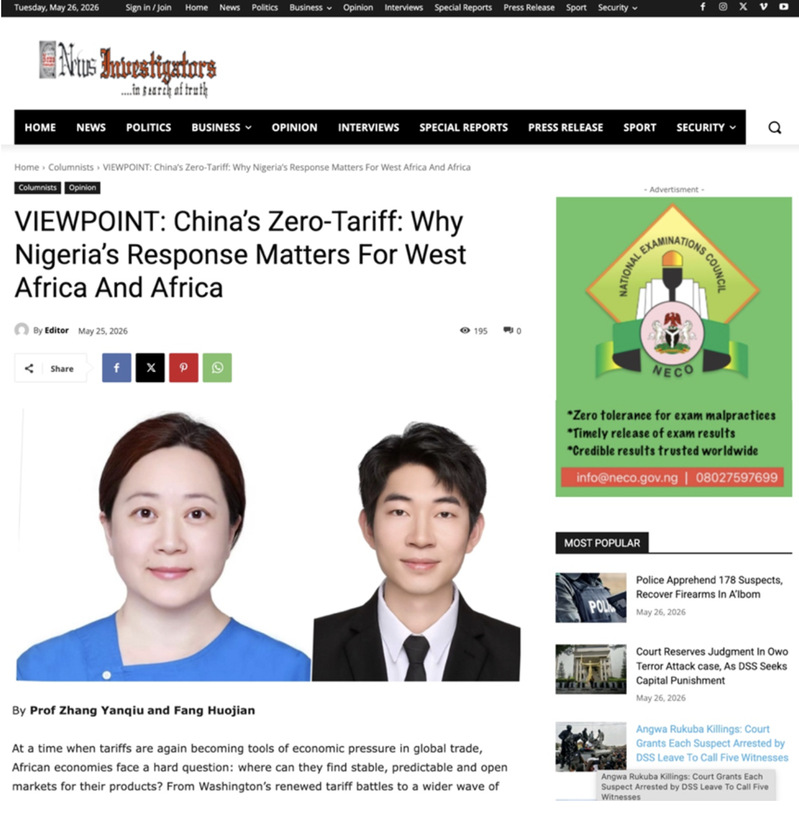 文章以中国对53个非洲建交国全面实施零关税政策为背景,强调在当前全球贸易保护主义抬头、关税壁垒加剧的国际环境下,中国通过零关税政策进一步向非洲产品开放市场,为非洲国家提供了更加稳定、开放、可预期的市场准入通道,体现了中国推动构建开放包容的世界贸易体系、深化中非务实合作的积极意义。文章特别从尼日利亚视角展开论述,认为中国零关税政策不仅为非洲产品进入中国市场提供现实通道,也为非洲国家扩大对华出口、培育贸易新增长点、吸引加工制造投资、推动产业升级和促进人文交流创造了重要机遇。文章强调,尼日利亚作为非洲人口大国和西非重要经济体,其回应不仅关系本国非油出口增长和产业能力提升,也关系西非地区如何更好连接中国市场、参与区域供应链和价值链合作。零关税政策的真正成效,不仅取决于关税减免本身,更取决于尼日利亚及非洲国家能否提升物流、认证、质量标准、加工制造和出口组织能力,将市场准入转化为价值增值、就业创造、区域联通和中非合作的可见发展成果。
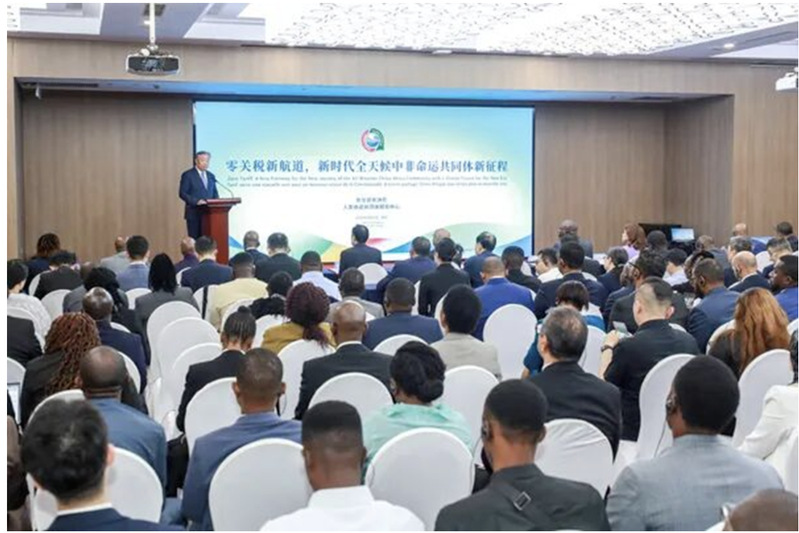
该篇评论文章是对5月22日在北京举办的“零关税新航道,新时代全天候中非命运共同体新征程”研讨会会议主旨及参会嘉宾发言的回应。22日,张艳秋副院长受邀出席了本次研讨会。研讨会由外交部非洲司和人类命运共同体研究中心共同主办,中非双方政府官员、非洲驻华使节、专家学者等200余人与会。外交部副部长苗得雨出席开幕式并致辞。苗得雨表示,中国自5月1日起对53个非洲建交国全面实施零关税政策,具象化诠释了习近平主席提出的真实亲诚对非政策理念和正确义利观,为新时代中非合作开辟新航道,为构建新时代全天候中非命运共同体注入新动能,为动荡的世界提供了宝贵的稳定性。会议聚焦如何推动零关税政策红利转化为贸易增长、产业合作和发展收益。与会嘉宾围绕非洲对华出口、产贸投一体化、人文交流、全产业链合作提质升级以及中非关系高质量发展等议题进行了深入交流。肯尼亚驻华大使贝特、来华参加零关税专题研修班的非方学员代表等发言,他们高度评价中国为构筑开放包容的世界贸易体系发挥领导作用,均认为零关税有助于带动非洲出口、投资和基础设施建设,促进中非合作走实走深。这一举措是中国扩大对非市场开放、推动中非经贸合作提质升级的重要实践,也为非洲国家培育贸易新增长点、提升产业能力、参与全球市场提供了新的制度性通道。
文章全文:
VIEWPOINT: China’s Zero-Tariff: Why Nigeria’s Response Matters For West Africa And Africa
ByProf Zhang Yanqiu and Fang Huojian
At a time when tariffs are again becoming tools of economic pressure in global trade, African economies face a hard question: where can they find stable, predictable and open markets for their products? From Washington’s renewed tariff battles to a wider wave of protectionist pressure, the rules of trade are becoming more uncertain. For developing countries trying to diversify exports, build industries and create jobs, this is not a distant fight among major powers. It reaches farmers, manufacturers and small businesses, shaping whether their products can enter global markets on fair and reliable terms.
Against this backdrop, China’s zero-tariff opening to Africa sends a clear signal. Since May 1, products from 53 African countries with diplomatic relations with Beijing have received zero-tariff treatment, giving African exporters wider access to one of the world’s largest consumer and industrial markets. At a moment when some major economies are raising barriers, China is lowering a direct cost for African goods entering its market. The policy matters not only because it cuts tariffs, but because it offers African economies a clearer route to market access amid global trade uncertainty.
The question came into sharper focus at a high-level seminar in Beijing on May 22, held under the theme “Zero-Tariff: A New Pathway for the New Journey of the All-Weather China-Africa Community with a Shared Future for the New Era.” Jointly hosted by the Department of African Affairs of China’s Ministry of Foreign Affairs and the Research Center on Building a Shared Future for Humanity, the seminar brought together Chinese and African officials, diplomats, scholars, business leaders and media representatives to discuss one central issue: how to turn tariff-free access into real trade and development gains. At the opening ceremony, Chinese Vice Foreign Minister Miao Deyu described the policy as opening a new window of opportunity for China-Africa trade, especially African exports to China. For Nigeria, that window opens onto a direct question: China has opened the door, but can Nigeria, West Africa and Africa as a whole organise themselves to walk through it?
In the weeks since implementation began, the policy has moved quickly from conference talk to customs clearance. South African apples, Kenyan avocados, Egyptian oranges, Moroccan gypsum, South African wine and pharmaceutical raw materials have already entered China under the new arrangement. For Nigerian readers, one item stands out: Nigerian crushed bovine bones have also been cited under the zero-tariff framework. Lesotho’s Ambassador to China, Mapaballo Lydia Mile, captured the policy’s practical value: by lowering the cost of entry, zero tariff can help African countries cultivate new growth points in trade. This is no distant promise or symbolic gesture. It is becoming a working trade channel, showing China’s willingness to turn its commitments to Africa into concrete market access. The question now is whether Nigeria can turn that access into a wider strategy for export growth, industrial upgrading and regional influence.
Nigeria is positioned at the centre of this discussion because its response will matter beyond its borders. As Africa’s most populous country, one of its largest economies and a major West African player, Nigeria is not just another beneficiary of China’s market opening. Such access lowers a visible barrier to trade, gives exporters more predictability and encourages producers to invest in standards, processing and scale. That gives Nigeria a chance to shape how the wider region connects to one of the world’s largest consumer and industrial markets. Nigerian officials and business commentators have already linked the zero-tariff policy to non-oil export diversification, job creation, industrial expansion and private-sector participation. That is the right starting point. The real test now is whether Nigerian producers, exporters and institutions can meet the demands of that market.
That readiness cannot be taken for granted. Nigerian media and industry stakeholders have pointed to familiar obstacles: high transport costs, weak cold chains, port delays, slow certification, uneven quality compliance and poor coordination among government agencies. These are not small technical details. They decide whether a product can move from a Nigerian farm, factory or processing site to a Chinese buyer. A favourable tariff rate may cut customs costs, but it cannot fix logistics, packaging, inspection, traceability or stable supply. Zero tariff, then, is not a guarantee of market success. It is a test of export discipline, and Nigeria’s ability to pass that test will determine how much value it can draw from the new opening.
This is where Nigeria’s strategy has to move beyond raw-material exports. The deeper promise of zero tariff lies in value addition. At the seminar, Opoku, a senior official from Ghana’s Ministry of Trade and Industry, offered a telling example: the policy could draw investment into cocoa processing, allowing cocoa powder or chocolate, not just raw cocoa beans, to enter the Chinese market under favourable terms. The lesson for Nigeria is clear. From agriculture and leather to solid minerals, food processing, light manufacturing and creative goods, the goal is not simply to export more, but to export better: with more processing, stronger branding, higher standards and more value kept at home. Export ambition, however, has to move carefully alongside domestic needs. Food security and price pressures cannot be ignored. A serious zero-tariff strategy needs to be selective, phased and coordinated, expanding exports without weakening domestic supply.
Seen this way, Nigeria’s response is no longer only a national question. It becomes a West African, even continental, one. Other African countries are already looking for their place in this new trade landscape. At the seminar, Mauritius’ Ambassador to China, Gaetan Siew Hew Sam, offered one example, presenting Mauritius as a bridge between China and the African continent through its legal system, financial services, language capacity and growing role in renminbi settlement. Nigeria’s strengths are different, but potentially more powerful for West Africa: population, market scale, ports, industrial base, entrepreneurial energy, banking networks and regional influence. If these assets are better organised, Nigeria could become a gateway through which West African products, processing capacity and trade services connect more effectively with China. Zero tariff may cover the continent, but its benefits will not spread automatically. Many African economies still face fragmented supply chains, limited processing capacity, weak transport corridors and, in some cases, no direct access to the sea. A stronger Nigerian export ecosystem could therefore create wider regional gains.
This also speaks to the future quality of China-Africa relations. At the Beijing seminar, Kenyan Ambassador to China Willy Bett praised China’s role in building a more open and inclusive world trading system, saying the zero-tariff policy could boost African exports, investment and infrastructure development. Egyptian Ambassador to China Khaled Nazmy added that trade and people-to-people exchanges can reinforce each other as African products reach more Chinese consumers. Together, their remarks point to the wider meaning of the policy: China is adding a practical new layer to China-Africa cooperation by opening one of the world’s largest markets more widely to African products. Yet the real test lies beyond conference halls and policy statements. It lies in whether African firms grow, jobs are created, technology reaches factories and farms, regional trade becomes stronger, and ordinary people feel the benefits.
For Nigeria, the zero-tariff opening is both an opportunity and a responsibility. Used merely as a favourable tariff arrangement, its gains may remain limited. Used as a catalyst for export readiness, value addition, regional leadership and industrial upgrading, its benefits could be far greater. China has opened a new door; what matters now is whether Nigeria, West Africa and Africa can enter it as producers, processors and strategic partners in a more balanced China-Africa economic future.
Author Information
Zhang Yanqiu is Professor of Communication, Vice Dean of the Institute for a Community with Shared Future, Director of Africa Communication Research Center at the Academy of International and Regional Communication Studies, Communication University of China. Her research focuses on African media Studies and China-Africa communication and cooperation.
Fang Huojian is a PhD student at the State Key Laboratory of Media Convergence and Communication, Communication University of China. His research focuses on international communication and African media studies.