

4月21日,马来西亚最著名的英文报纸《星报》The Star开设的“人类命运共同体”主题专栏“On A Shared Future”,发表了人类命运共同体研究院张艳秋副院长,和区域与国别研究博士生吴荻共同撰写的文章《向东看:高频元首外交凸显中国在变局全球秩序中的崛起力量》(Look East: Frequent Head-of-State Diplomacy Highlights China’s Rising Role in a Shifting Global Order)。以下转载全文。
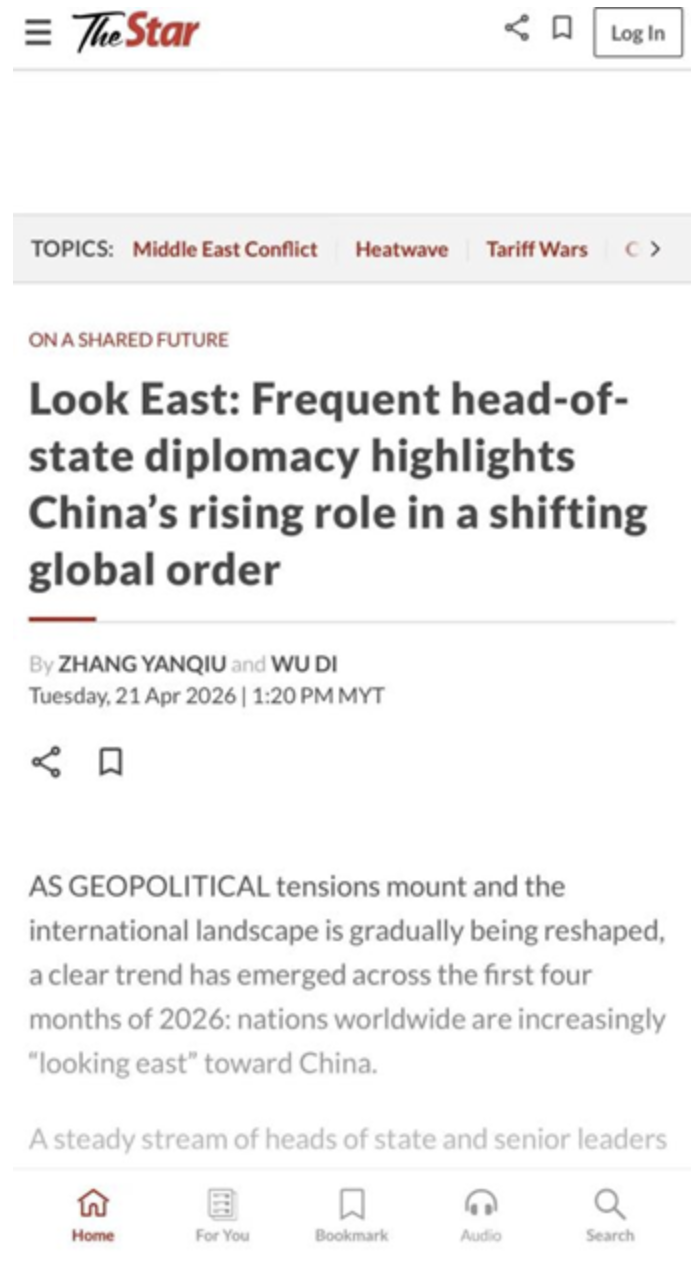
Look East: Frequent Head-of-State Diplomacy Highlights China’s Rising Role in a Shifting Global Order
By ZhangYanqiu, Professor, Deputy Dean, Institute for a Community with Shared Future, Academy of International And Regional Communication Studies, Communication University of China.
Wu Di, PhD Candidate, School of International Studies, Communication University of China.
As geopolitical tensions mount, the international landscape is gradually being reshaped, a clear trend has emerged across the first four months of 2026: nations worldwide are increasingly “looking east” toward China. A steady stream of heads of state and senior leaders have visited Beijing and other Chinese cities, engaging in intensive diplomatic exchanges that underscore China’s central position in global cooperation and governance.
From January to April 2026, high-level visits to China have spanned regions and priorities, reflecting broad-based confidence in China’s development and partnership. In early 2026, the Prime Minister of Canada Mark Carney, the Prime Minister of Finland Petteri Orpo, and the President of Uruguay Yamandu Orsi visited China, focusing on economic dialogue, trade stabilization, and bilateral investment cooperation. Canadian and Chinese leaders agreed to restart high-level economic and financial talks, aiming to expand two-way trade and create a fair business environment for enterprises.
April brought an exceptionally concentrated wave of diplomacy. The Prime Minister of Spain Pedro Sánchez Pérez-Castejón paid his fourth visit to China in four years, emphasizing stronger collaboration in trade, new energy, and technology. He praised Chinese investment as a driver of Spain’s economic growth and expressed strong interest in deepening industrial and green cooperation.
Sheikh Khaled bin Mohamed bin Zayed Al Nahyan, Crown Prince of Abu Dhabi, came to Beijing to enhance energy, infrastructure, and trading partnerships, affirming the UAE’s commitment to advancing practical cooperation for mutual benefit. Russian Foreign Minister Sergey Lavrov held in-depth talks on major global and regional issues, with both sides stressing the need to uphold a fair and rational international order.
General Secretary of the Communist Party of Vietnam (CPV) Central Committee and Vietnamese President To Lam chose China as his first overseas destination after being elected president, highlighting the priority of bilateral ties. The two sides agreed to upgrade cooperation in the economy, trade, railways, and tourism, strengthening their traditional friendly partnership. Shortly afterward, President of the Republic of Mozambique Chapo Daniel Francisco Chapo arrived in China to expand cooperation in agriculture, infrastructure, and investment, linking national development strategies with China’s initiatives.
Across all these meetings, a consistent message stands out: partners seek closer alignment with China’s growth momentum, stable policy frameworks, large-scale market, and long-term industrial planning. Leaders repeatedly noted that cooperation with China delivers tangible benefits, supports job creation, and strengthens national competitiveness.
Beyond high-level meetings, tangible economic achievements reinforce why countries are eager to cooperate with China. China’s GDP grew 5.0% year-on-year in the first quarter of 2026, outperforming most major economies and serving as a global economic stabilizer. Its trade with Belt and Road countries accounts for 51.2% of total trade, with double-digit growth in trade with ASEAN, Africa, Latin America and the EU. Foreign direct investment confidence in China rose to fourth globally, driven by its AI leadership and massive market. These economic strengths provide practical value for partners: stable demand, advanced technology, and long-term policy certainty that contrasts with Western short-termism and fragmentation.
This wave of “look east” is more than diplomatic courtesy. It signals a quiet but decisive shift in global influence. As Western economies grapple with structural challenges, fragmented policies, and short-term pressures, China offers consistent, long-term strategic direction, massive industrial capacity, and an open, inclusive approach to shared growth.
China is not simply a passive recipient of diplomatic attention. It acts as a stabilizing force in a turbulent world, advocating peaceful development, win-win cooperation, and respect for national sovereignty. By hosting intensive head-of-state diplomacy, China strengthens bilateral partnerships, contributes to global economic recovery, and supports a more balanced, multipolar international order.
In the coming months, the trend of “look east” is set to continue. For countries navigating global uncertainty, engagement with China has become a pragmatic, strategic choice—one that links their own prosperity to a more stable and prosperous world.