
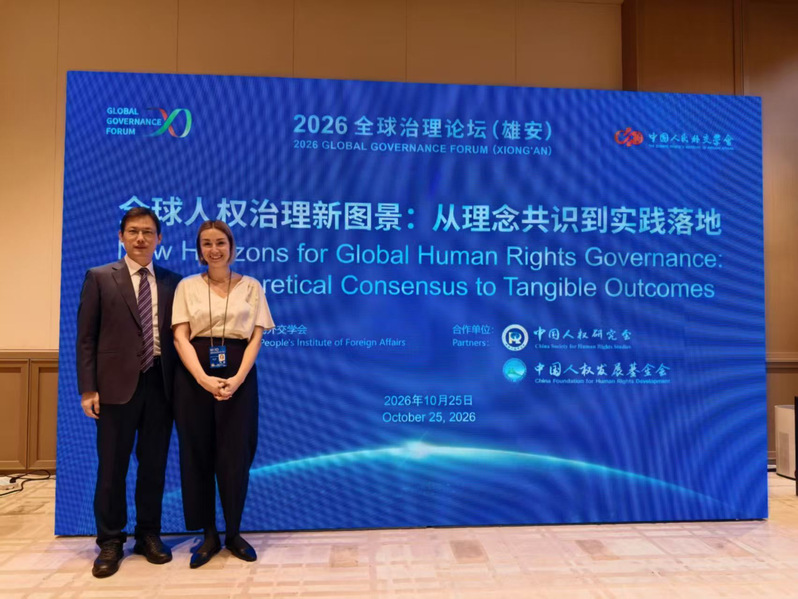
Dr. Maria Francesca Staiano, Director of the Latin American Research Academy of Community with a Shared Future and the Belt and Road Initiative (BRI) at the Communication University of China (CUC), and Coordinator of the Center for Chinese Studies (CeChino) at the Institute of International Relations (IRI), National University of La Plata (UNLP), Argentina, participated as an invited speaker in the Global Governance Forum 2026, held in Xiong'an, China, from October 23 to 25, 2026, held under the theme “Rebuilding Confidence and Cooperation: Reforming and Improving Global Governance in a Transforming World.”The Forum brought together international scholars, policymakers, and experts to address the evolving challenges of global governance, the future of multilateralism, and the need for more inclusive and equitable mechanisms of international cooperation.
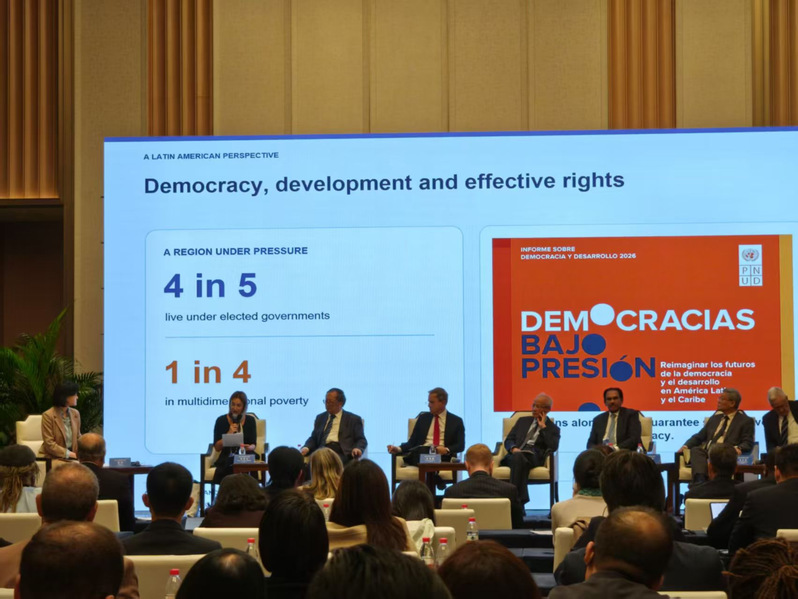
Dr. Staiano's participation provided an opportunity to contribute a Latin American perspective to the global debate on international governance, particularly regarding the relationship between international law, human rights, sustainable development, technological transformation, and the vision of building a community with a shared future for humanity.
Her contribution also reflected the academic mission of the Latin American Research Academy, fostering intellectual exchange between China and Latin America and promoting interdisciplinary dialogue on shared global challenges. In this context, her participation helped strengthen the Academy's international academic engagement and highlighted opportunities for future cooperation in global governance research, comparative legal studies, and the governance of emerging technologies.
The Forum was inaugurated on October 23 by China's Minister of Foreign Affairs, Wang Yi, who delivered a keynote address and read a message from President Xi Jinping emphasizing the importance of strengthening international cooperation and advancing a more just and equitable global governance system.
Dr. Staiano contributed to the thematic session “Practicing Multilateralism and Safeguarding the UN-Centered International System”, delivering a presentation entitled: “From AI for Good to Global Governance for Good: A Latin American Perspective on Shared Development.”
Her presentation examined contemporary challenges in global governance from a Latin American perspective, focusing on the interconnected dimensions of technological development, human rights, social justice, and international cooperation.
A central argument of her contribution was the need to move beyond formal commitments to multilateralism toward more effective, inclusive, and substantive forms of global governance, grounded in international law, sovereign equality, mutual respect, and dialogue among civilizations.
Within this framework, she explored China's Global Governance Initiative (GGI) and its relationship with the broader vision of building a community with a shared future for humanity, highlighting the potential for constructive dialogue between Chinese governance proposals and Latin American approaches to development, institutional capacity, and human rights.
A distinctive aspect of her presentation was the incorporation of recent Latin American and international normative frameworks, particularly the United Nations Development Programme's 2026 Democracy and Development Report, Democracies Under Pressure: Reimagining the Futures of Democracy and Development in Latin America and the Caribbean, and Resolution No. 2/26 of the Inter-American Commission on Human Rights, Fiscal Policies and Human Rights in the Americas.
Drawing on these instruments, Dr. Staiano emphasized the fundamental role of effective state capacities, inclusive fiscal policies, and rights-based public governance in translating formal legal guarantees into substantive rights and tangible improvements in people's lives.
She argued that meaningful democracy and sustainable development require not only institutional recognition of rights but also the material, financial, technological, and administrative conditions necessary for their effective realization.
Building on this perspective, her presentation advanced a concrete proposal to strengthen China–Latin America cooperation in artificial intelligence governance through the establishment of joint research and policy laboratories, bringing together universities, public administrations, legal scholars, technology specialists, and human rights experts.
These collaborative platforms would aim to promote the co-production of knowledge, the joint development of governance standards, institutional capacity-building, and the exchange of regulatory experiences, moving beyond traditional models of unilateral technology transfer toward more reciprocal, inclusive, and mutually beneficial forms of cooperation.
The proposal also underscored the importance of positioning Latin America as an active contributor to emerging global governance frameworks, rather than merely as a recipient of externally developed technological and regulatory models.
From an institutional perspective, Dr. Staiano's participation represented a valuable contribution to the international academic dialogue promoted by the Latin American Research Academy of Community with a Shared Future and BRI at the Communication University of China.
Her intervention helped articulate a research agenda connecting Chinese approaches to global governance with Latin American perspectives on human rights, substantive democracy, sustainable development, and technological cooperation.
It also identified promising directions for future China–Latin America academic collaboration, particularly in the fields of artificial intelligence governance, comparative legal studies, public policy, and institutional development.
Selected references:
CGTN – Global Governance Forum 2026
https://www.cgtn.com/specials/2026/global-governance-forum-xiongan.html
Global Times – Global Governance Forum Concludes in Xiong'an
https://www.globaltimes.cn/page/202610/1372926.shtml
Ministry of Foreign Affairs of China – Wang Yi's Keynote Address
https://www.fmprc.gov.cn/eng/wjbzhd/202610/t20261023_12046170.html