
Prof. Li Huailiang, Dean of Institute for a Community with Shared Future at Communication University of China
Distinguished guests, esteemed colleagues, and friends,
Good morning!
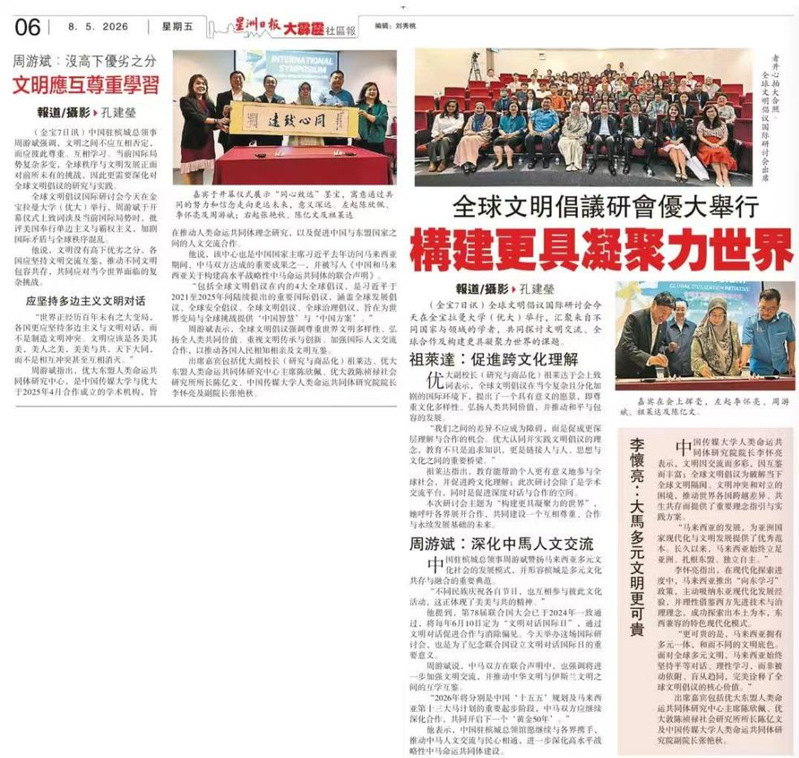
It is a great privilege to be here in beautiful Penang, representing the Institute for a Community with Shared Future at Communication University of China. I extend my warmest congratulations on the successful opening of this International Symposium on Global Civilization Initiative.
My sincere thanks go to our colleagues at Universiti Tunku Abdul Rahman, Malaysia, whose unwavering dedication to civilizational dialogue makes events like this possible. I also commend the organizers and co-organizers for their outstanding work.
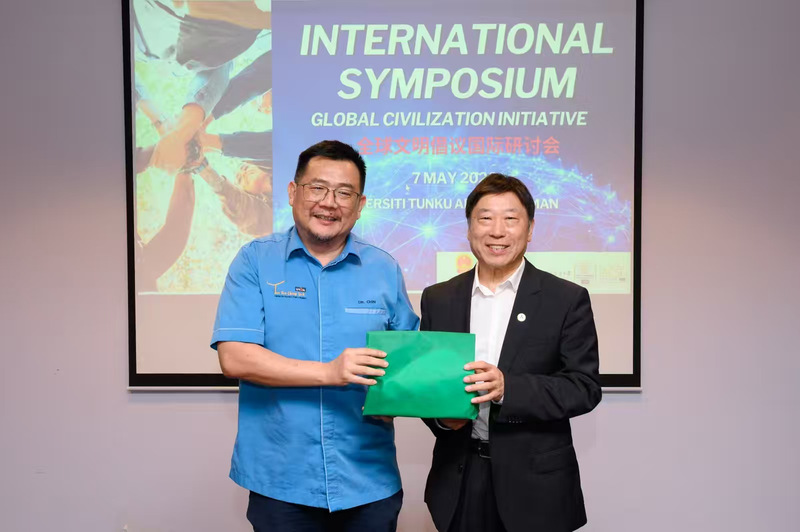
The Global Civilization Initiative (GCI) provides vital guidance for our times. It offers a path to transcend civilizational divides, resolve conflicts, and foster mutual understanding. This forum, with its focus on building an inclusive and symbiotic world, is both timely and essential. It creates a much-needed platform for cross-border dialogue on these critical issues.
China and Malaysia are connected by more than geography; we share cultural ties and a commitment to mutual support. We are a model of civilizational exchange and multilateral cooperation in Asia.
The establishment of the ASEAN Research Center fora Community with Shared Future by our two universities is a testament to this partnership. It has received strong endorsement from both our governments, as reflected in the China-Malaysia Joint Statement of April 2025. This official support provides a solid foundation for our work and underscores its significance.
Since its inception, the Center has operated on principles of equality, mutual trust, and practical cooperation. Our joint efforts are already bearing fruit:
We have launched a dedicated column in Malaysia’s leading newspaper, The Star, to share the vision of a shared future for mankind with the ASEAN public.
In November 2025, we successfully hosted a thematic forum that brought together scholars from across the region to discuss pathways to regional symbiosis.
Our joint research has produced significant outcomes, including studies on cultural development in G20 countries and AI application in higher education across China, Malaysia, and the Philippines.
We are also compiling a special publication to mark the 80th anniversary of the UN, interpreting global governance through the lens of South-South cooperation.
Furthermore, we have established regular academic exchanges, facilitating in-depth visits for faculty, students, and researchers, thereby strengthening the cultural bonds between our two countries.
Reflecting on Asia’s modernization journey, I am convinced that the essence of civilizational exchange is not blind imitation, but adaptation that is rooted in local contexts. While some paths have, at times, moved away from Asia’s cooperative spirit, Malaysia’s approach offers a compelling example.
Malaysia has consistently charted its own course—anchored in Asia, committed to ASEAN, and focused on regional development. By leveraging its strategic position, Malaysia actively promotes economic cooperation, regional governance, and people-to-people ties, steadfastly rejecting zero-sum thinking in favor of mutual benefit.
Malaysia’s Look East policy exemplifies this pragmatic and inclusive wisdom. It skillfully integrates useful elements from both Eastern and Western experiences, crafting a unique modernization model that is both locally grounded and globally engaged. In diplomacy, Malaysia upholds true multilateralism, advocating for equality and mutually beneficial cooperation among nations.
Perhaps most impressively, Malaysia’s multi-ethnic and multi-cultural fabric—harmoniously blending Malay, Chinese, Indian, and other traditions—stands as a living example of civilizational dialogue. In the face of global diversity, Malaysia engages proactively, learning rationally rather than conforming passively. This perfectly embodies the GCI’s core principles: respecting civilizational diversity, promoting mutual learning, and rejecting any sense of civilizational superiority.
As to Japan, one of our neighbors,this country's learning, imitation and even dependence on western culture have brought it certain successover the past century or so. But now, its blind worship and dependence on western culture, especially that of the United States, have restricted its development and become an obstacle. Japan has lost three decades. The dependent path it has taken will cause it to lose another three decades in the future. In contrast, the cultural path Malaysia has adopted, which is rooted in Asia and oriented towards the world, will serve as a firm foundation, ensuring its prosperity in the future.
Dear colleagues, friends,
As the world undergoes profound changes, challenges like geopolitical rivalry, civilizational fragmentation, and ideological confrontation are becoming more acute. Building an inclusive global order is a common task for all humanity. The deepening cooperation between our two institutions is a practical effort to bring the vision of the GCI to life in ASEANand in Asia.
Looking ahead, we are committed to leveraging ASEAN Research Center fora Community with Shared Future as our primary platform. We will deepen our collaboration in academic research, talent development, cultural exchange, and knowledge sharing. We will continue to tell the story of Asia’s civilizational dialogue, ASEAN’s multilateralism, and the enduring friendship between China and Malaysia.
We will use academic insight to bridge differences, and cultural exchange to build consensus. In doing so, we aim to contribute to the ASEAN Community, to the China-Malaysia community with a shared future, and to a world that is peaceful, prosperous, and inclusive for all.
Finally, I wish this InternationalSymposiumonGlobalCivilizationInitiative a resounding success! I wish you all productive discussions, and the very best in your important work.
Thank you.